Leading University Creating Innovation for Sustainable Future

Healthy University Rating System (HURS)
University : Siam University
Country : Thailand
Web Address : https://sustainability.siam.edu
SI 5 Health promotion curriculum and co-curriculum
[5.1] Integration of Health Promotion in Core University Curriculum – evidence from course specifications (TQF 3)
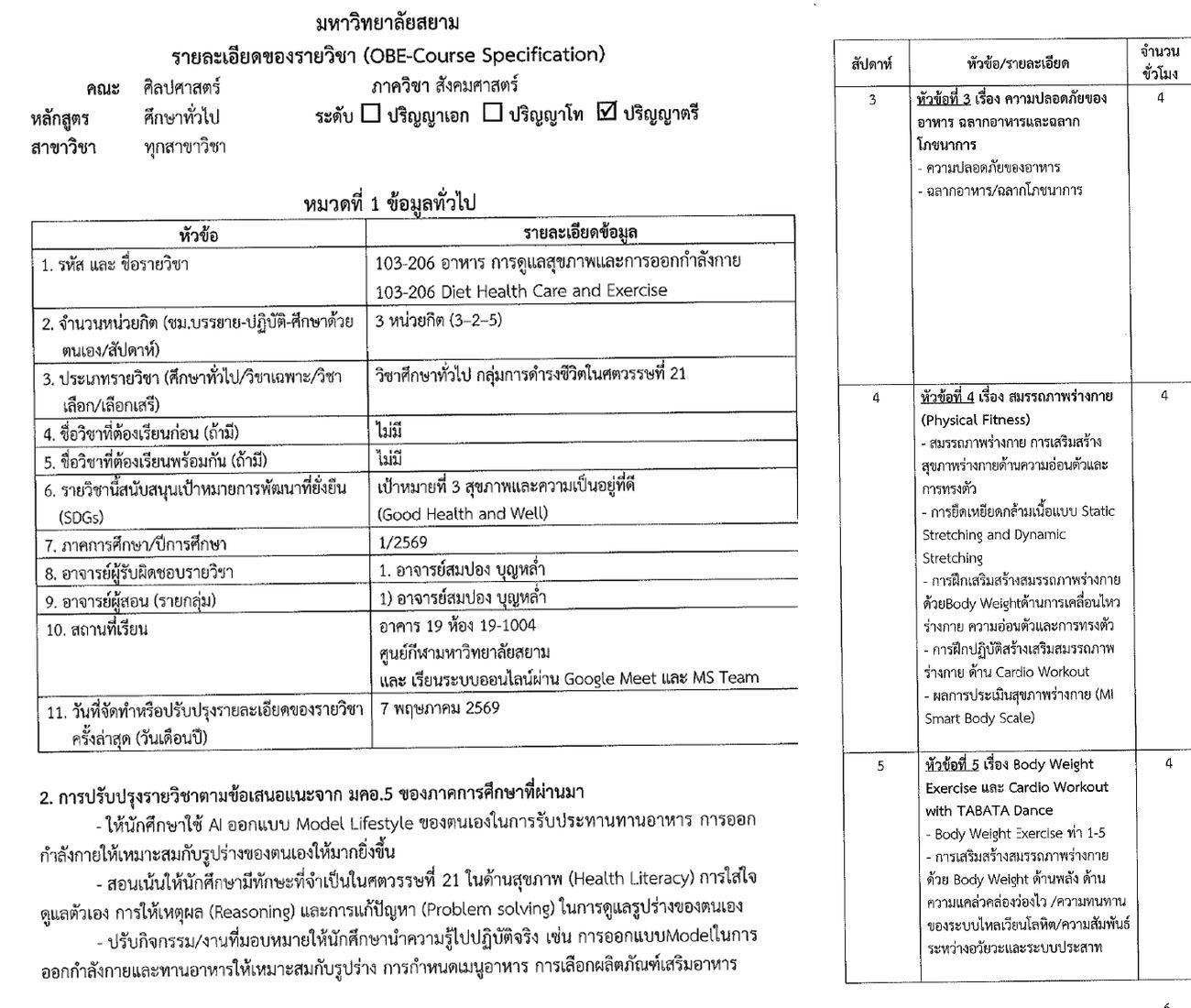 |
| 103-206 Diet, Health Care and Exercise, Semester 1/2569 – (Left) SDG 3 and course improvements for health literacy (Right) Weekly plan: food safety, physical fitness and exercise training |
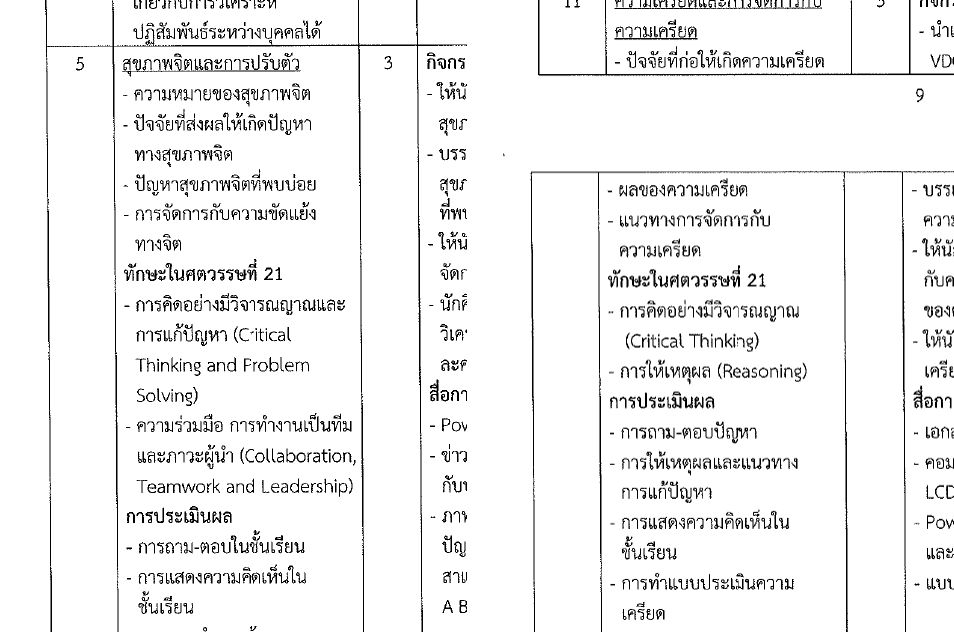 |
| 103-212 Psychology and Life Development, Semester 1/2569 – (Left) Week 5 Mental health and adjustment (Right) Week 11 Stress and stress management |
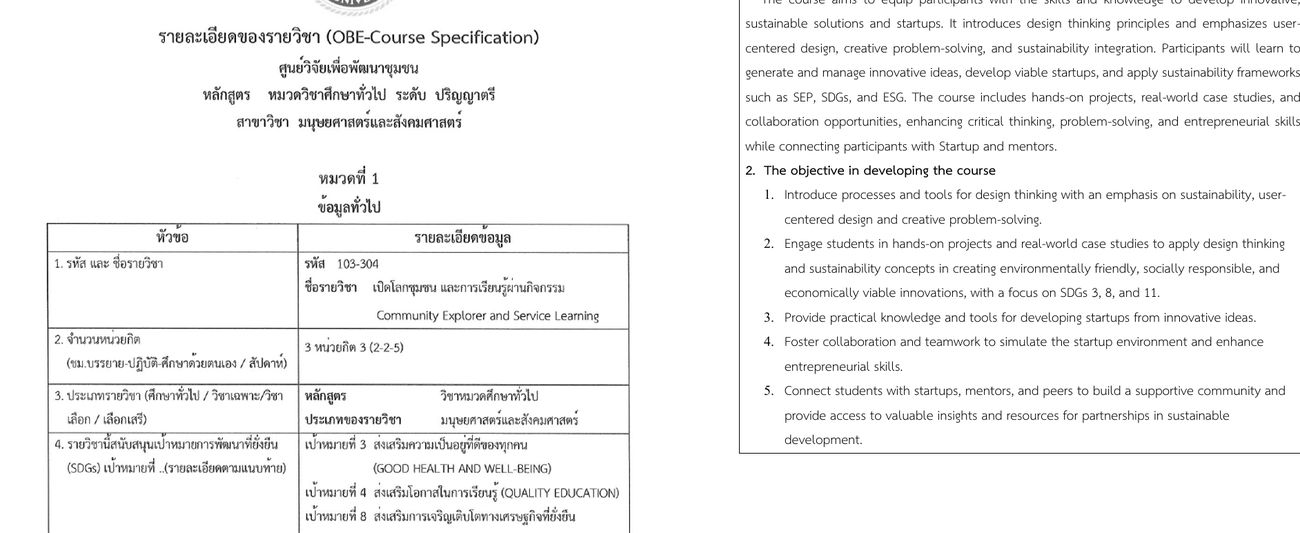 |
| (Left) 103-304 Community Explorer and Service Learning – SDG 3 Good Health and Well-being (Right) 117-602 Design Thinking – innovation projects with a focus on SDGs 3, 8 and 11 |
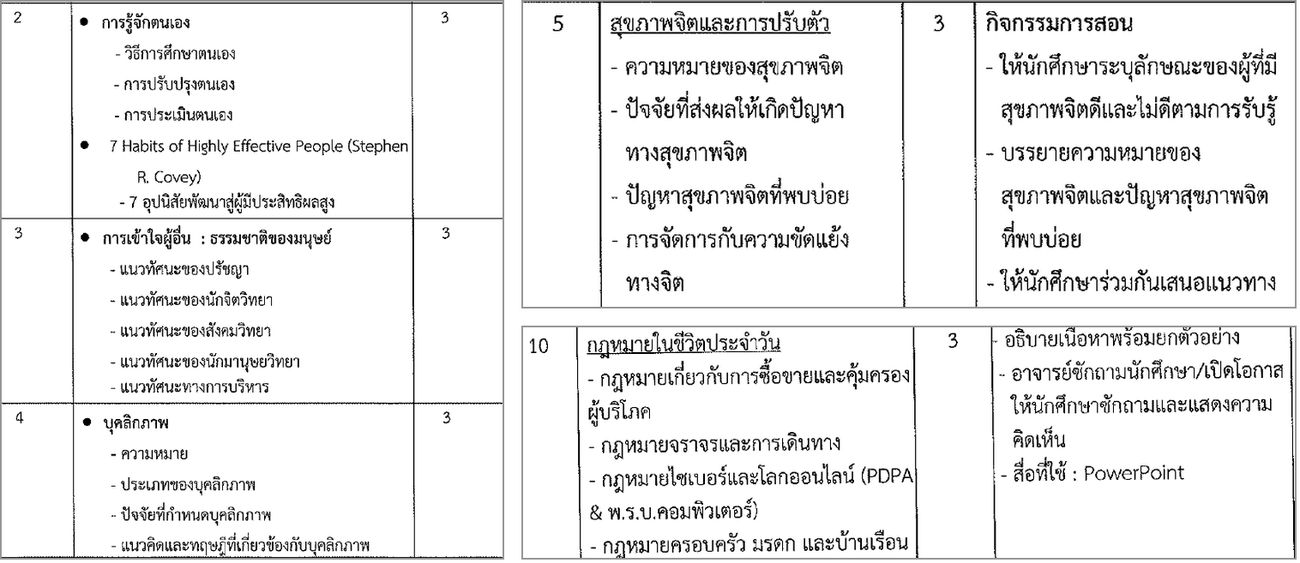 |
| (Left) 103-204 Human Relations and Personality Development, Weeks 2–4: self-knowledge, understanding others and personality (Right, top) 103-205 Psychology in Daily Life, Week 5: mental health and adjustment (Right, bottom) 103-203 Civic Literacy, Week 10: laws in daily life – consumer protection, traffic, cyber law and PDPA |
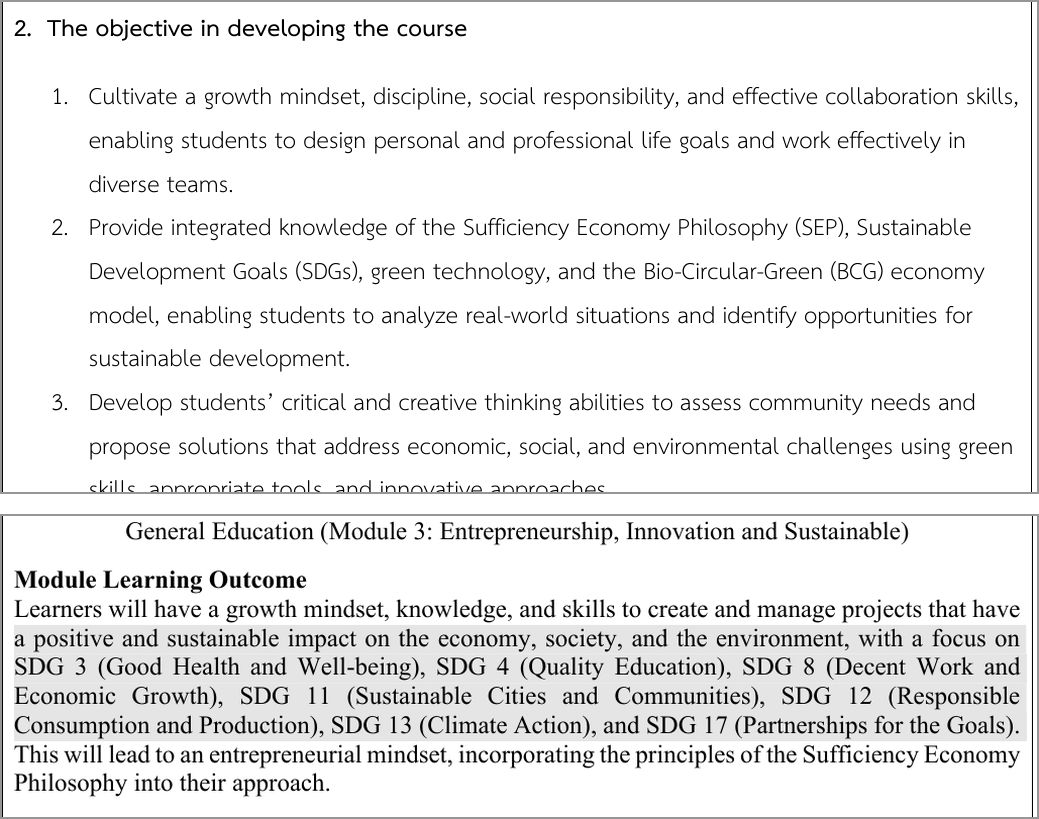 |
| (Top) 117-601 Dreams, Ideas and Sustainability – course objectives: life goals, social responsibility and community needs (Bottom) 117-603 Business Canvas and Project Management – Module 3 learning outcome with a focus on SDG 3 Good Health and Well-being |
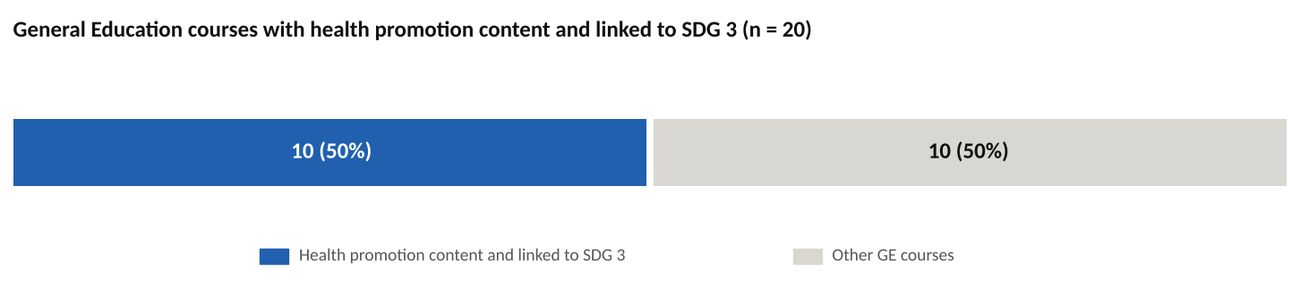 |
| 10 of the 20 General Education courses (GI 8) – 50% – include health promotion content and are linked to SDG 3 Good Health and Well-being |
| Health promotion in General Education course specifications – TQF 3 (Siam University, Thailand) |
Description:
This report reviews the course specifications (TQF 3) of ten General Education (GE) courses taught in academic years 2568–2569 for health promotion content as defined by HURS – physical health, mental wellness, nutrition, personal hygiene, disease prevention and public health advocacy – and for their link to SDG 3 Good Health and Well-being. All ten courses include health promotion content and are linked to SDG 3 (Table 1). The core curriculum has 20 General Education courses (GI 8), including 103-204 and 103-205, which belong to GE Group 2, Competencies for Living in the 21st Century. 10 of the 20 courses (50%) therefore integrate health promotion (Table 2).
Physical health and nutrition. 103-206 Diet, Health Care and Exercise (SDG 3) covers food safety and nutrition labels, physical fitness testing, body-weight, cardio and weight training, diet for weight control and the prevention of non-communicable diseases, dietary supplements and first aid. Following the previous course report (TQF 5), it now places more emphasis on health literacy, and students use AI to design their own diet and exercise plans.
Mental, emotional and social well-being. 103-212 Psychology and Life Development and 103-205 Psychology in Daily Life teach the meaning of mental health, the causes of mental health problems, common mental health problems, coping with mental conflict and stress management; 103-212 includes a stress self-assessment. 103-204 Human Relations and Personality Development covers self-knowledge, understanding others, personality development, positive thinking and teamwork, and 103-209 Art and Music Appreciation teaches the use of music and art to sustain the mind in daily life.
Safe and healthy communities. 103-203 Civic Literacy in Thai and Global Context teaches laws in daily life – consumer protection, traffic law, cyber law and personal data protection – which support road safety, consumer protection and online safety. 103-304 Community Explorer and Service Learning (SDGs 3, 4 and 8) studies the ageing society and community development through fieldwork in Phasi Charoen.
Module 3 – Entrepreneurship for Sustainability. The learning outcome of this compulsory module asks students to create and manage projects with a positive and sustainable impact on society, with a focus on SDG 3 Good Health and Well-being. 117-601 asks students to set personal and professional life goals with a growth mindset and to apply the Sufficiency Economy Philosophy to daily life and community needs; 117-602 sets innovation and startup projects aligned with SDGs 3, 8 and 11; and 117-603 applies business models and project management to social enterprises and sustainable projects.
Selected level: 25–50% of Courses – 10 of 20 points (10 of 20 GE courses = 50%). [50% is the upper limit of this level. One more course with health promotion content would give 11 of 20 = 55% and the level 51–75%.]
Table 1 – Health promotion content and SDG 3 in GE course specifications (TQF 3)
| Code | Course | Semester | SDGs in TQF 3 | Health promotion content in the course specification | Health promotion and SDG 3 |
|---|---|---|---|---|---|
| General Education electives | |||||
| 103-203 | Civic Literacy in Thai and Global Context | 1/2569 | 3, 4, 5, 15, 16 | Week 10 laws in daily life: consumer protection, traffic law (road safety), cyber law and personal data protection (PDPA), labour law; rights, duties and anti-corruption for a safe and fair society | Yes |
| 103-204 | Human Relations and Personality Development (GE Group 2) | 1/2569 | 3, 4 | Self-knowledge and self-improvement; understanding others; personality and personality development; positive thinking; human relations, communication and teamwork – social and emotional well-being | Yes |
| 103-205 | Psychology in Daily Life (GE Group 2) | 1/2569 | 3, 4, 8 | Week 5 mental health and adjustment: meaning of mental health, causes of mental health problems, common mental health problems, coping with mental conflict; stress management | Yes |
| 103-206 | Diet, Health Care and Exercise | 1/2569 | 3 | Physical, mental, emotional and social well-being; food safety and nutrition labels; physical fitness testing; body-weight, cardio and weight training; diet for weight control and NCD prevention; dietary supplements; first aid | Yes |
| 103-209 | Art and Music Appreciation | 1/2569 | 4 (GE survey: 3, 4) | Week 9 music and life – using music in daily life; art and music to sustain the mind – mental well-being | Yes |
| 103-212 | Psychology and Life Development | 1/2569 | 3, 4, 8 | Week 5 mental health and adjustment; Week 10 healthy relationships; Week 11 stress and stress management, with a stress self-assessment; Week 12 positive thinking | Yes |
| 103-304 | Community Explorer and Service Learning | Summer 2568 | 3, 4, 8 | Population change and the ageing society; community analysis and participatory development in Phasi Charoen; fieldwork for community health and well-being | Yes |
| Module 3 – Entrepreneurship for Sustainability (compulsory) | |||||
| 117-601 | Dreams, Ideas and Sustainability according to the Sufficiency Economy Philosophy | 1/2568 | 8, 11, 12, 13, 17 (Module 3 outcome: 3) | CLO 1: growth mindset, discipline, social responsibility and the design of personal and professional life goals; the Sufficiency Economy Philosophy in daily life; Living Lab projects on community needs | Yes |
| 117-602 | Design Thinking for Creating Innovation and Startups Based on Sustainability | 2/2568 | 3, 8, 11 | Objectives and CLO 5: innovation and startup projects that align with SDGs 3, 8 and 11 | Yes |
| 117-603 | Business Canvas and Project Management for Sustainability | 2nd semester, year 1 | 3, 4, 8, 11, 12, 13, 17 (Module 3 outcome) | Projects with a positive and sustainable impact on society, with a focus on SDG 3 Good Health and Well-being; business models and project management for social enterprises | Yes |
Source: TQF 3 course specifications, academic years 2568–2569. The Module 3 learning outcome (SDG 3) is stated in the TQF 3 of 117-602 and 117-603.
Table 2 – General Education courses that integrate health promotion
| Courses | Number | Share |
|---|---|---|
| GE courses with health promotion content and linked to SDG 3 (Table 1) | 10 | 50% |
| Other GE courses | 10 | 50% |
| Total GE courses (GI 8) | 20 | 100% |
The core curriculum is the 20-course GE list reported in GI 8. The count used for SI 5.1 is in green.
Evidence to attach:
-
TQF 3 of the ten courses: 103-203, 103-204, 103-205, 103-206, 103-209, 103-212, 103-304, 117-601, 117-602 and 117-603.
-
TQF 5 course reports of these courses, with enrolment numbers and student course evaluations. [Attach.]
-
Official list of the 20 GE courses (GI 8), including 103-204 and 103-205 in GE Group 2. [Attach.]
NOTE – ข้อมูลที่ต้องยืนยันก่อนส่ง (ลบก่อนอัปโหลด)
-
นับได้ 10 จาก 20 วิชา = 50% (ระดับ 25–50%, 10 คะแนน) – 50% เป็นค่าสูงสุดของระดับนี้ ถ้าเพิ่มได้อีก 1 วิชา (เช่น 117-501 หรือ 117-503 ที่ผูกกับ SDG 3 ในแบบสำรวจ) จะได้ 11/20 = 55% (ระดับ 51–75%, 15 คะแนน)
-
รายการ 20 วิชาของ GI 8 ต้องมี 103-204 และ 103-205 อยู่ด้วย – ไฟล์ GI 8 และไฟล์ SI 5.1 หลัก ฉบับที่ 2 ยังใช้ 22 วิชา ต้องปรับให้ตรงกัน
-
117-601, 117-603 และ 103-203 ไม่มีหัวข้อสุขภาพโดยตรงในแผนการสอน – ถ้าผู้ประเมินไม่นับ จะเหลือ 7/20 = 35% (ระดับยังเป็น 25–50%)
-
มคอ.3 ของ 117-601 ไม่ได้ระบุ SDG 3 (ต่างจาก 117-602 และ 117-603 ในโมดูลเดียวกัน) และ มคอ.3 ของ 103-209 ระบุ SDG 4 อย่างเดียว – ควรเพิ่ม SDG 3 ใน มคอ.3 ของทั้งสองวิชา
-
HURS ขอจำนวนผู้เรียนและผลประเมินรายวิชา – ใช้ มคอ.5 ของวิชาเหล่านี้
PDF Attachments
- 103-203 ความเป็นพลเมืองในสังคมไทยและสังคมโลก (1).pdf
- 103-204 มนุษยสัมพันธ์และการพัฒนาบุคลิกภาพ.pdf
- 103-205 จิตวิทยาในชีวิตประจำวัน.pdf
- 103-206 อาหาร การดูแลสุขภาพและการออกกำลังกาย.pdf
- 103-209 ศิลปะและดนตรีเพื่อสุนทรียภาพแห่งชีวิต.pdf
- 103-212 จิตวิทยากับพัฒนาชีวิต.pdf
- 103-304 เปิดโลกชุมชนและการเรียนรู้ผ่านกิจกรรม.pdf
- 117-601 Dreams, Idea, and Sustainability According to Sufficiency Economy Philosophy.pdf
- 117-602 Design Thinking for Creating Innovation and Startup Based on Sustainability.pdf
- 117-603 Business Canvas and Project Management for Sustainable (2).pdf