Leading University Creating Innovation for Sustainable Future


Healthy University Rating System (HURS)
University : Siam University
Country : Thailand
Web Address : https://sustainability.siam.edu
ZT 6 Road Safety Violations including Helmet Use
[(ZT 6.1] Comprehensive Road Safety Measures
| 1. Student Union road-safety plan with the traffic police |
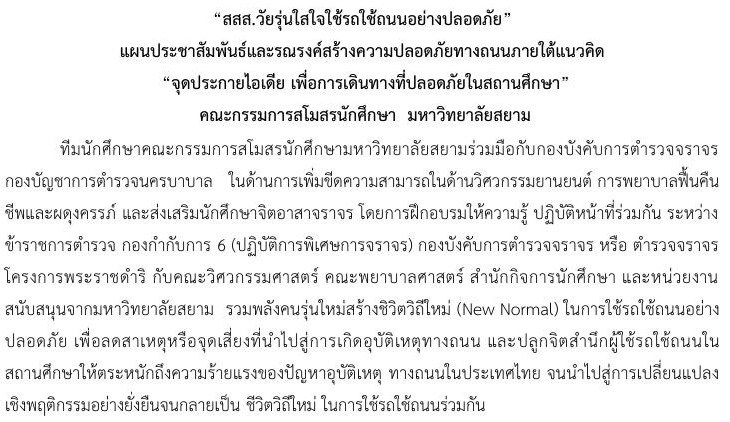 |
| “ThaiHealth – teens care about safe road use”: road-safety campaign plan of the Siam University Student Union Committee – work with the Traffic Police Division (Sub-Division 6, Royal Initiative traffic police), the Faculties of Engineering and Nursing and the Office of Student Affairs on training, resuscitation and student traffic volunteers |
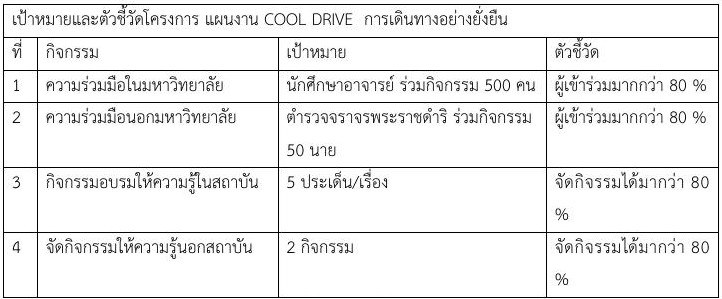 |
| COOL DRIVE targets and indicators: 500 students and lecturers, 50 traffic police officers, training on 5 topics and 2 outreach activities, each at more than 80% (Toyota White Road Campus Challenge 2025) |
| 2. Helmet campaign at freshmen orientation |
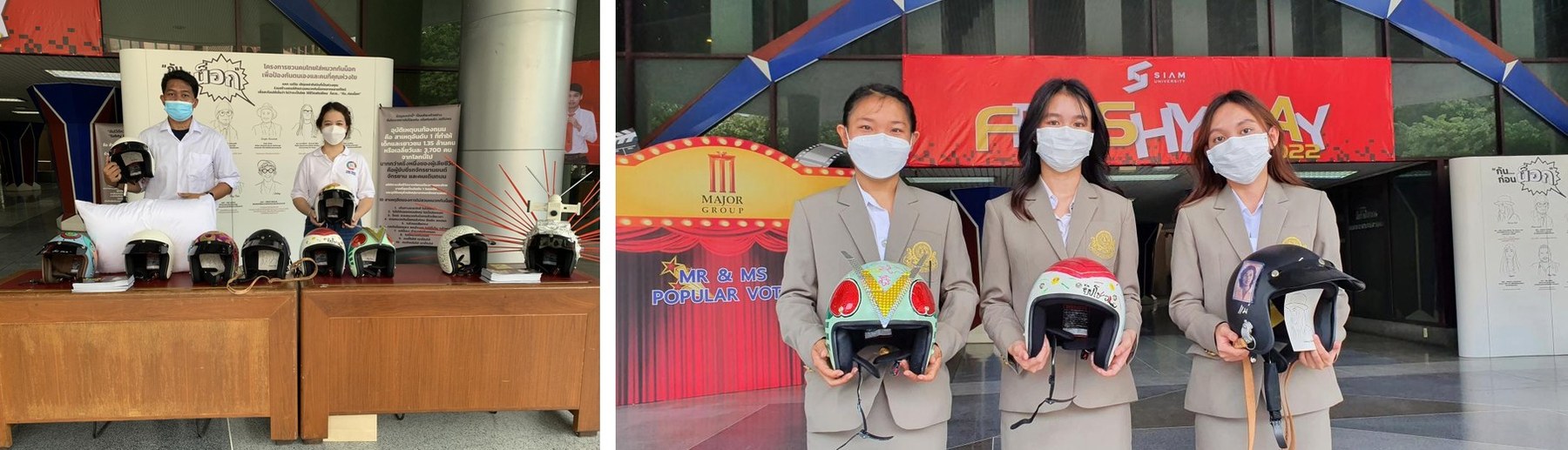 |
| Helmet exhibition “Protect before you crash”, inviting Thais to wear helmets to protect themselves and their loved ones: helmets decorated by artists, road-death facts and ten reasons people do not wear helmets; students show helmets at Freshy Day 2022 |
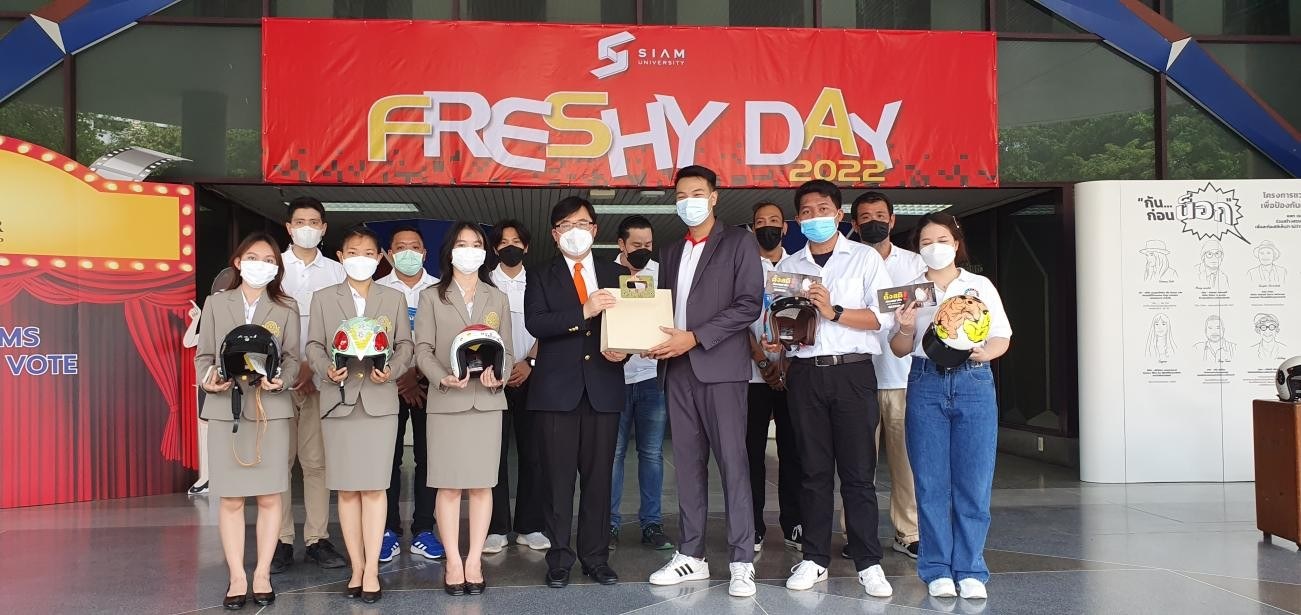 |
| Students and staff at the helmet campaign, Freshy Day 2022 (photos attached to the Student Union plan) |
| 3. Road-safety education in schools |
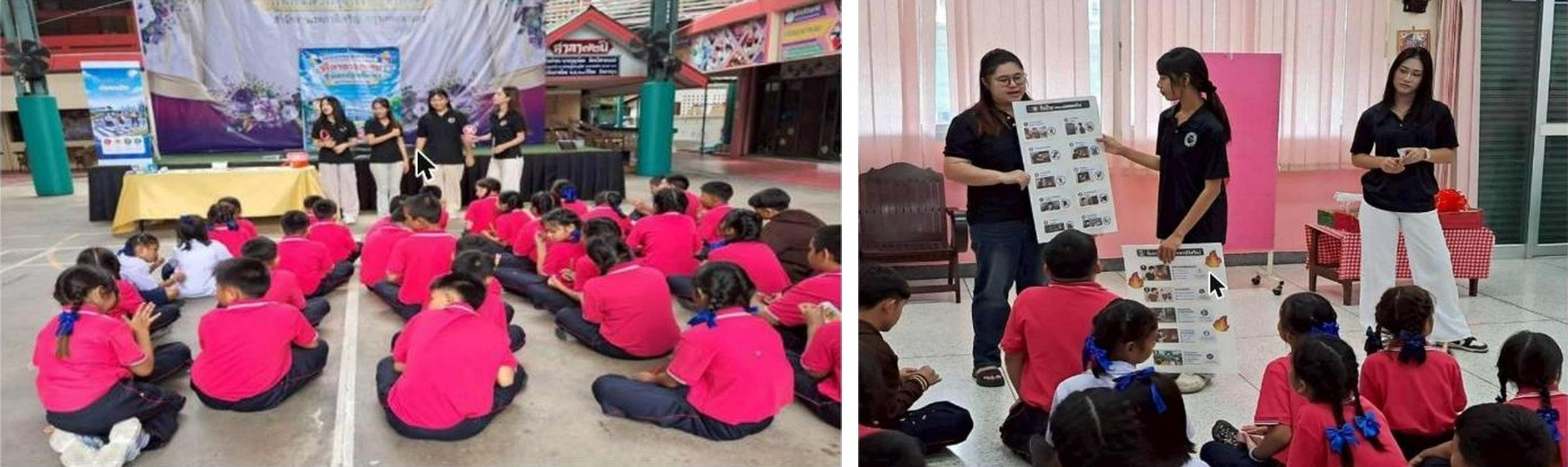 |
| Occupational Health and Safety students teach traffic rules for walking, cycling and public transport at Wat Pradu Bangchak School, 20 May 2026 (Sustainability Report 2025–2026, p. 50) |
| 4. Safety Policy and controlled vehicle access |
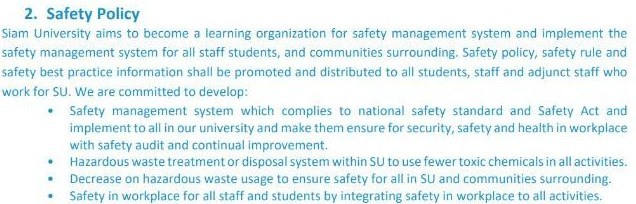 |
| Safety Policy of the Healthy University Policy: a safety management system for all staff, students and the surrounding community (Sustainability Report 2025–2026, p. 9) |
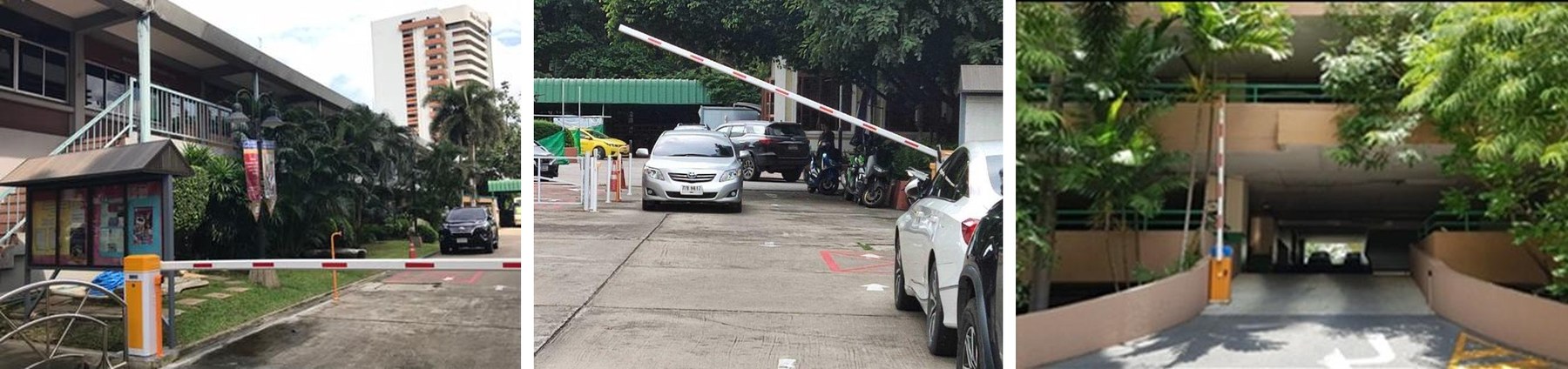 |
| Barrier gates with a security booth: only authorised vehicles enter the parking areas (UI GreenMetric 2026, TR 5.13–5.15) |
| 5. Safe environment for pedestrians |
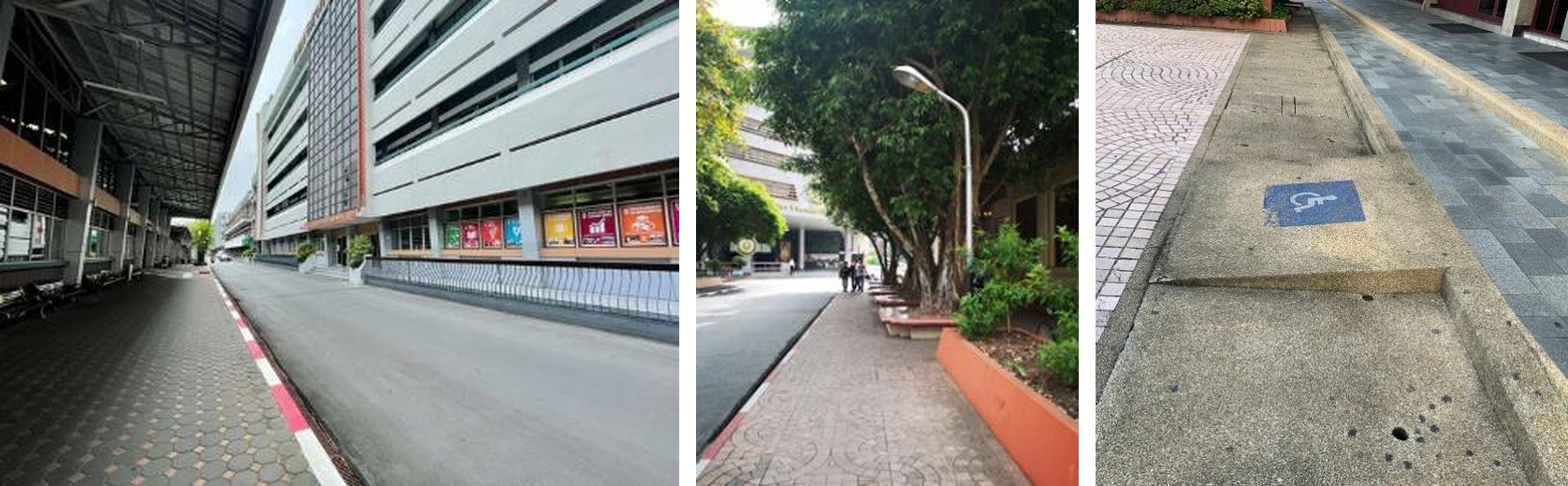 |
| Pedestrian paths separated from the road by kerbs, with lighting, CCTV, gentle slopes, ramps and tactile guiding blocks (TR 5.16) |
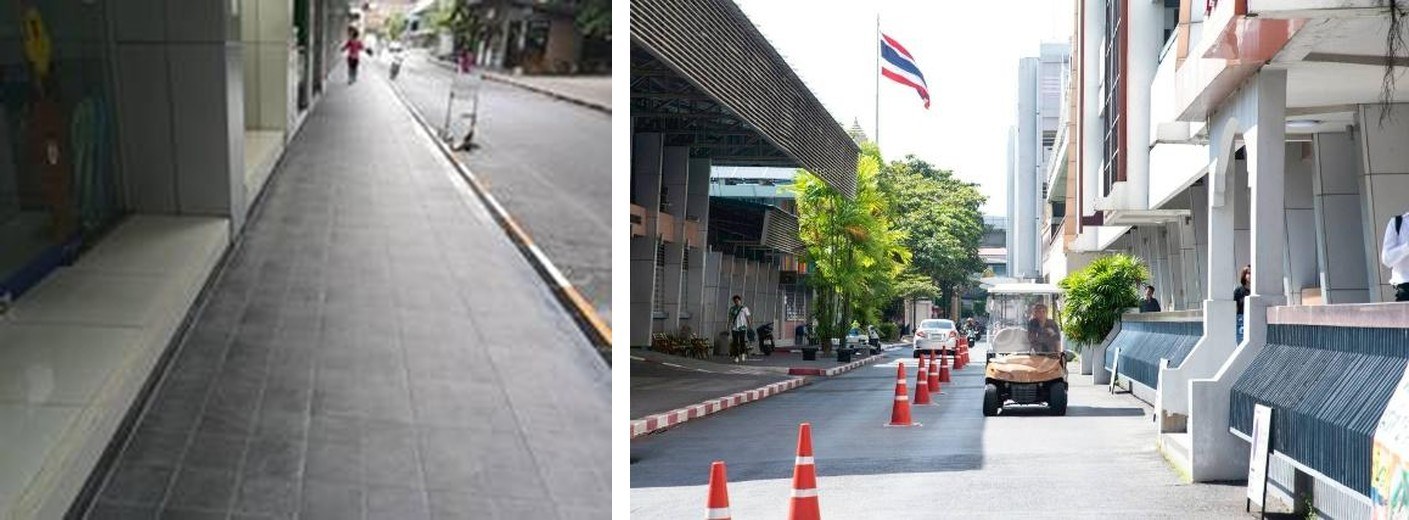 |
| (Left) Covered walkway beside the road (Right) Traffic cones separate the lane used by electric carts from car traffic |
| 6. First aid and emergency preparedness |
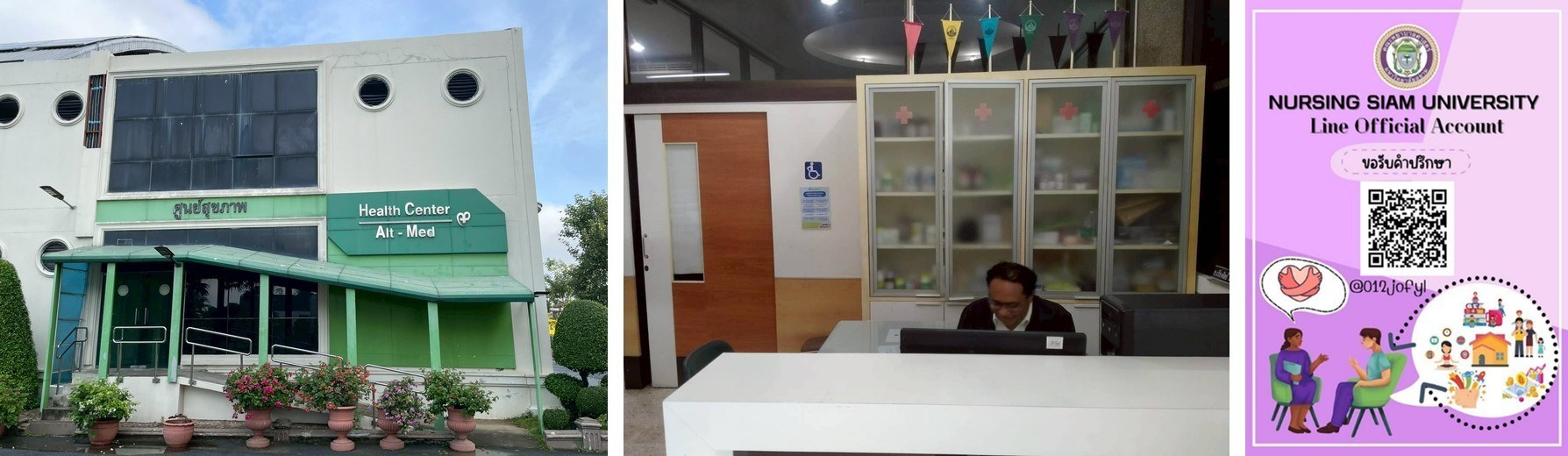 |
| Health Center – free health services for students and staff and first point of care for injuries – and the Faculty of Nursing LINE Official Account for health advice |
Description:
Siam University has a single, compact campus of 78,160 m² on Phetkasem Road, Phasi Charoen, about 500 m from the Bang Wa BTS and MRT stations. Most students and staff arrive by public transport and walk, and only about 95 vehicles (41 motorcycles) enter the campus on a typical day. The Safety Policy of the Healthy University Policy commits the University to a safety management system for all staff, students and the surrounding community, with safety rules promoted to everyone, safety audits and continual improvement.
Student-led campaigns with the traffic police. The Siam University Student Union Committee runs the road-safety plan “COOL DRIVE – sustainable travel” (Toyota White Road Campus Challenge 2025, with ThaiHealth), together with the Traffic Police Division’s Royal Initiative traffic police, the Faculties of Engineering and Nursing and the Office of Student Affairs. It tackles road rage, careless driving and drink-driving through training on five topics, campaigns at freshmen orientation, announcements, posters and online media, student traffic volunteers and outreach to schools and communities, with a budget of THB 31,000 (Tables ZT 6.1.1–6.1.2). A helmet campaign was also held at Freshy Day 2022 (photos attached to the plan).
Rules, education and environment. Vehicle access is controlled by barrier gates with security booths, and helmets and seat belts are compulsory under the Land Traffic Act B.E. 2522. Road safety is also taught in 153-222 Traffic Engineering and 261-434 Occupational Health and Safety Management in Transportation, and Occupational Health and Safety students teach traffic rules in local schools. Pedestrian paths are separated from the road and have lighting, CCTV, ramps and guiding blocks; shuttle buses and free zero-emission vehicles reduce motorcycle trips.
Emergency care. Injured people receive first care at the on-campus Health Center; the COOL DRIVE plan includes Faculty of Nursing training for Royal Initiative traffic police in resuscitation and emergency midwifery, and first aid and basic life support are taught in the Faculties of Medicine and Nursing.
Table ZT 6.1.1 – COOL DRIVE road-safety plan of the Student Union
| Element | COOL DRIVE – sustainable travel (Siam University Student Union Committee, 2025) |
|---|---|
| Programme | “ThaiHealth – teens care about safe road use”: road-safety campaign plan “Spark ideas for safe travel in educational institutions”, Toyota White Road Campus Challenge 2025 |
| Problems addressed | Road rage, careless driving and drink-driving among young people; root causes identified as stress, state of mind at the time, and drugs or alcohol. In Thailand 74.4% of road deaths are motorcycle users (data cited in the plan). |
| Partners | Traffic Police Division, Metropolitan Police Bureau (Sub-Division 6 – special traffic operations, the Royal Initiative traffic police); Phasi Charoen traffic police and district office; Faculty of Engineering (automotive engineering); Faculty of Nursing (resuscitation and emergency midwifery); Office of Student Affairs; ThaiHealth |
| Good-driver skills | Driving skills; lower speed and no carelessness; traffic discipline; courtesy to other road users; traffic volunteering – inside and outside the University |
| Target groups | Students and lecturers; Royal Initiative traffic police officers; road users, schools and communities around the University |
| Activities | Planning meeting and media; training for student leaders; workshop with the traffic police and a memorandum of cooperation; traffic-volunteer duty on campus and with the police; “COOL Freshy” orientation campaign; outreach to schools and communities; lessons-learned session (four-month plan, August–November) |
| Communication | Public-address announcements and posters on campus; traffic-police channels; University and Student Union websites, video clips and government websites |
| Budget | THB 31,000 (Table ZT 6.1.2) |
Source: Student Union Committee plan “ThaiHealth – teens care about safe road use”, Toyota White Road Campus Challenge 2025 (attached PDF). Project advisor: Director of the Office of Student Affairs.
Table ZT 6.1.2 – COOL DRIVE targets, evaluation and budget
| Indicator | Target | Success level |
|---|---|---|
| 1. Participation inside the University | 500 students and lecturers take part | More than 80% of the target |
| 2. Participation outside the University | 50 Royal Initiative traffic police officers take part | More than 80% of the target |
| 3. Training inside the University | 5 road-safety topics | More than 80% of activities held |
| 4. Outreach outside the University | 2 activities (community and schools) | More than 80% of activities held |
| “Travel Buddies” road-safety club | Members from at least 3 faculties | More than 100 members |
| Memorandum of cooperation with the Royal Initiative traffic police |
Students, lecturers and traffic police run activities together | Joint activities for 3 years |
| Publication of results | Campaign media produced | Published inside and outside the University |
| Prevention of road-traffic injuries through the University’s health system |
An internal unit runs accident-prevention activities | Measured through the University’s traffic report system |
Indicators 1–4: awareness and implementation targets; the other four rows: how success is evaluated. Results to be filled from the activity reports.
| Budget item | THB |
|---|---|
| Training for 50 student leaders (THB 50 each) | 2,500 |
| Speakers for student-leader training (2 × THB 500) | 1,000 |
| Campaign signs (5 × THB 500) | 2,500 |
| Design of online media | 1,000 |
| Training for 40 Royal Initiative traffic police officers (THB 100 each) |
4,000 |
| Speakers for police training (4 × THB 500) | 2,000 |
| Traffic volunteer activities | 8,000 |
| Equipment and materials (lump sum) | 10,000 |
| Total | 31,000 |
Budget for the four-month plan, from the attached plan.
Table ZT 6.1.3 – HURS road-safety measures at Siam University
| HURS measure | Implementation at Siam University | Evidence |
|---|---|---|
| 1. Enforcement of rules against road-safety violations, including seat belts and helmets, on and around campus |
The Safety Policy of the Healthy University Policy commits the University to a safety management system for all staff, students and the surrounding community, with safety rules promoted to everyone. Vehicle access is controlled: only authorised vehicles enter the parking areas, through barrier gates with security booths, and high fees apply in some areas, so only about 95 vehicles (41 motorcycles) enter on a typical day. Helmets for riders and passengers and seat belts for car occupants are compulsory under the Land Traffic Act B.E. 2522. Around the campus, the Student Union works with the Traffic Police Division (Sub-Division 6, Royal Initiative traffic police) and Phasi Charoen traffic police to organise student traffic-volunteer duty (COOL DRIVE plan), and district officers manage traffic during large events (Siam Sports Fair, 20–29 March 2026). |
Photos 1, 4; COOL DRIVE plan; SDG Report 2025–2026, pp. 9, 28; TR 5.4, 5.13, 5.15 |
| 2. Road-safety education for students and staff | Student campaigns: the Student Union’s “COOL DRIVE” plan (Toyota White Road Campus Challenge 2025, with ThaiHealth) targets road rage, careless driving and drink-driving among students through training on five road-safety topics, campaigns at freshmen orientation (“COOL Freshy”), public-address announcements, posters, and online media on the University and Student Union websites; the target is 500 students and lecturers. Helmet campaign at Freshy Day 2022: an exhibition inviting Thais to wear helmets to protect themselves and their loved ones, with helmets decorated by artists, facts on road deaths and ten reasons people do not wear helmets. Curriculum: 153-222 Traffic Engineering and 261-434 Occupational Health and Safety Management in Transportation (safe driving behaviour, driver readiness, alcohol and drug control). Outreach: Occupational Health and Safety students taught traffic rules at Wat Pradu Bangchak School (20 May 2026). |
Photos 2, 3; COOL DRIVE plan; SDG curriculum mapping 2569; SDG Report 2025–2026, p. 50 |
| 3. Safe environment that minimises the risk of traffic accidents |
Pedestrian paths separated from vehicle roads by kerbs and handrails, with electric and solar lighting, CCTV, gentle slopes, covered walkways, direction signs, ramps and tactile guiding blocks; traffic cones separate lanes where carts and cars share a road. Little traffic on campus: parking covers only 2.89% of the 78,160 m² campus and has been cut by more than 30% in three years. Free zero-emission transport inside the campus (5 electric cars, 20 e-scooters, 29 bicycles, 2 electric golf carts) and BTS and MRT stations about 500 m away. |
Photos 4, 5; TR 5.13, 5.14, 5.15, 5.16, 5.18 |
| 4. Emergency management protocol and training for traffic injuries |
The on-campus Health Center gives free health services to students and staff and is the first point of care for injuries. The COOL DRIVE plan includes training by the Faculty of Nursing for 40 Royal Initiative traffic police officers in resuscitation and emergency midwifery, and road-traffic injury prevention is to be measured through the University’s health system and traffic report system. First aid and basic life support are taught in 260-312, 261-410 (Faculty of Medicine) and 170-347 First Aid and Resuscitation (Faculty of Nursing); the Occupational Health and Safety programme runs an annual campus evacuation drill (9 June 2025). |
Photos 6; COOL DRIVE plan; SDG Report 2024–2025, p. 45; SDG curriculum mapping 2569 |
| 5. Other road-safety measures | Student traffic volunteers (“จิตอาสาจราจร”) to serve with the Royal Initiative and Phasi Charoen traffic police in and around the campus; a planned memorandum of cooperation with the traffic police for three years and a “Travel Buddies” road-safety club with members from at least three faculties. Fewer motorcycle trips: shuttle buses for medical and nursing students, carpooling and free zero-emission vehicles. Local partnership: the President chairs the Phasi Charoen District Participatory Development Steering Committee, whose work covers traffic management and order and safety (SDG Report 2024–2025, p. 124). |
Photos 1, 7; COOL DRIVE plan; TR 5.14, 5.15, 5.18; SDG Report 2024–2025, p. 124 |
Green: in place. Orange: in place or partly in place; evidence to be added. “Photos” refers to the numbered sections above; “TR 5.x” to the UI GreenMetric 2026 Transportation evidence files.
Table ZT 6.1.4 – Measures counted for the level
| Measure | Recommended count | Conservative count |
|---|---|---|
| 1. Enforcement of rules | Yes | No – no written university rule |
| 2. Road-safety education | Yes | Yes |
| 3. Safe environment | Yes | Yes |
| 4. Emergency protocol | No (partly in place) | No |
| 5. Other measures | Yes | Yes |
| Measures counted | 4 → 4 Items or More | 3 → 3 Items |
| Score (20 × weight) | 20 × 1.00 = 20 | 20 × 0.75 = 15 |
The HURS description of “4 Items or More” mentions both preventive policies and emergency management protocols, so the traffic-injury procedure (item 4) is the most useful document to add.
Evidence to attach:
-
Student Union road-safety plan COOL DRIVE (Toyota White Road Campus Challenge 2025) and activity reports.
-
Healthy University Policy – Safety Policy: https://sustainability.siam.edu/vision-mission-and-policies-for-sustainable-future/; Sustainability Report 2025–2026, pp. 9, 28, 50: https://sustainability.siam.edu/wp-content/uploads/2026/10/SDG_report_2025_2026.pdf
-
SDG 3 page (road-safety project, 20 May 2026): https://sustainability.siam.edu/goal-3/
-
SDG Report 2024–2025, pp. 45 (evacuation drill) and 124 (district committee): https://sustainability.siam.edu/wp-content/uploads/2025/10/SDG-report-2024-2025.pdf
-
UI GreenMetric 2026 Transportation evidence TR 5.4, 5.13, 5.14, 5.15, 5.16 and 5.18 (attached PDFs).
-
SDG curriculum mapping 2569 – 153-222, 261-434, 260-312, 261-410, 170-347; Faculty of Nursing article on motorcycle-accident prevention in youth: https://e-research.siam.edu/kb/road-traffic-accident/
-
University rule on helmets and seat belts, gate-check records, traffic-injury procedure and first-aid training records.
[ZT 6.2] Compliance with Helmet Use Among Motorcyclists
Description:
Helmet use is measured by direct observation at the vehicle gates and motorcycle parking areas, as HURS recommends, checked against gate CCTV footage. Because only about 41 motorcycles enter the campus on a typical day, every motorcycle passing during the observation sessions is counted rather than a sample (Table ZT 6.2.1). The observers will be student traffic volunteers trained in the Student Union’s COOL DRIVE programme, working with Occupational Health and Safety students and security staff, and the results feed the University’s traffic report system. The 2026 result is the baseline for later years.
Initiatives to encourage helmet use. Helmets are compulsory under the Land Traffic Act; a helmet campaign was held at freshmen orientation (Freshy Day 2022), and the Student Union’s COOL DRIVE plan adds training, campaigns and student traffic volunteers working with the traffic police (Table ZT 6.2.3). Their effect will be seen by comparing the helmet-use rate year by year and by gate.
Table ZT 6.2.1 – Observation protocol
| Element | Observation protocol, academic year 2026 |
|---|---|
| Population of motorcyclists | About 41 motorcycles enter the campus on a typical day (UI GreenMetric 2026, TR 5.4); riders and passengers are both counted. |
| Locations | All vehicle gates and the motorcycle parking areas (campus map below) |
| Times | Morning arrival 07:30–09:00, midday 11:30–13:00 and evening departure 16:00–18:00, on randomly chosen days covering every weekday and one Saturday, over two weeks. |
| Observers | Student traffic volunteers and “Travel Buddies” club members trained in the COOL DRIVE programme, with Occupational Health and Safety students and security staff; two observers per gate, trained together so that they count in the same way. |
| Sample size | Every motorcycle passing during the sessions; target at least 400 rider and passenger observations, which gives the helmet-use rate within about ±5% at 95% confidence. |
| Recording | Each rider and passenger is recorded as “helmet worn correctly / not worn” on a tally sheet; gate CCTV footage for the same sessions is reviewed to check the counts. No number plates or faces are recorded. |
| Supplementary survey | One question in the Healthy Campus Survey (with ZT 1.2 and ZT 2.2): “When you ride or travel as a passenger on a motorcycle, how often do you wear a helmet?” (always / usually / sometimes / never). |
| Analysis | Helmet use (%) = people wearing a helmet ÷ all riders and passengers observed × 100, reported for riders, passengers and in total, with 95% confidence intervals; results by gate and time of day. Results go to the University’s traffic report system (COOL DRIVE indicator 4). |
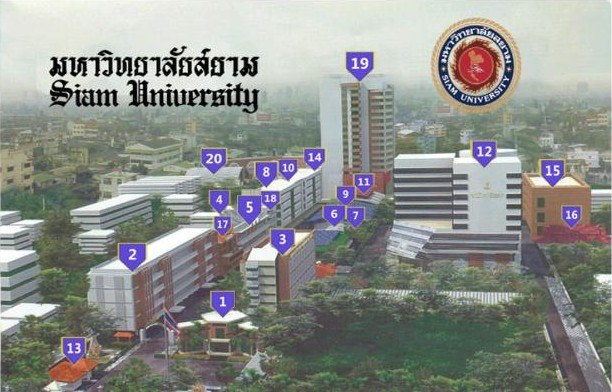 |
| Campus map, 38 Phetkasem Road, Phasi Charoen – observation points: the vehicle gates and the motorcycle parking areas (ico.siam.edu/campus-map) |
Table ZT 6.2.3 – Initiatives that encourage helmet use
| Initiative to encourage helmet use | What it does | Expected effect on compliance |
|---|---|---|
| Land Traffic Act and controlled gates | Helmets compulsory for riders and passengers; only authorised vehicles enter |
Riders entering campus are known and can be reminded |
| Helmet campaign at freshmen orientation (Freshy Day 2022) | Exhibition of helmets decorated by artists; facts on road deaths and ten reasons for not wearing helmets |
New students start with the habit |
| COOL DRIVE training and campaign | Training on 5 road-safety topics; posters, announcements, online media; target 500 students and lecturers |
Higher awareness and peer pressure |
| Student traffic volunteers with the traffic police (planned) | Volunteers to serve in and around the campus and observe helmet use |
Visible checks at gates; data for follow-up |
Sources: COOL DRIVE plan; helmet campaign photographs (Freshy Day 2022); Land Traffic Act B.E. 2522; TR 5.13–5.15.
Evidence to attach:
-
Helmet observation tally sheets or CCTV summary and schedule.
-
Helmet campaign and COOL DRIVE photographs with dates.
-
Campus map: https://ico.siam.edu/campus-map; motorcycles per day – UI GreenMetric 2026, TR 5.4.