Leading University Creating Innovation for Sustainable Future


Healthy University Rating System (HURS)
University : Siam University
Country : Thailand
Web Address : https://sustainability.siam.edu
ZT 5 Violence, Bullying and Sexual Harassment
[5.1] Comprehensive Measures Against Violence, Bullying, and Sexual Harassment
| 1. Harassment Policy |
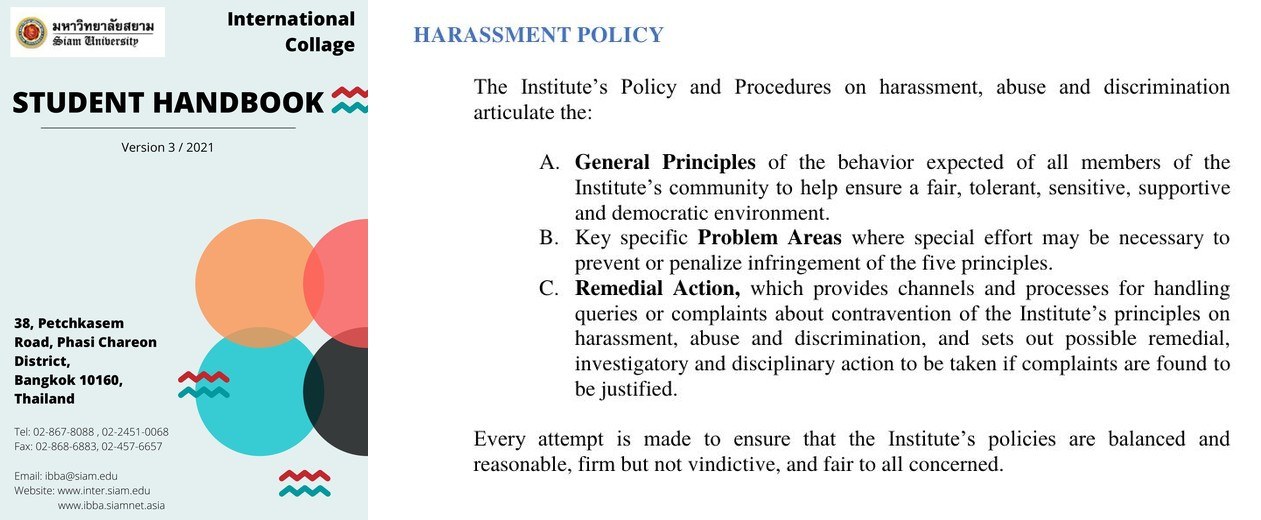 |
| Student Handbook, International College (version 3/2021): Harassment Policy – general principles, problem areas and remedial action |
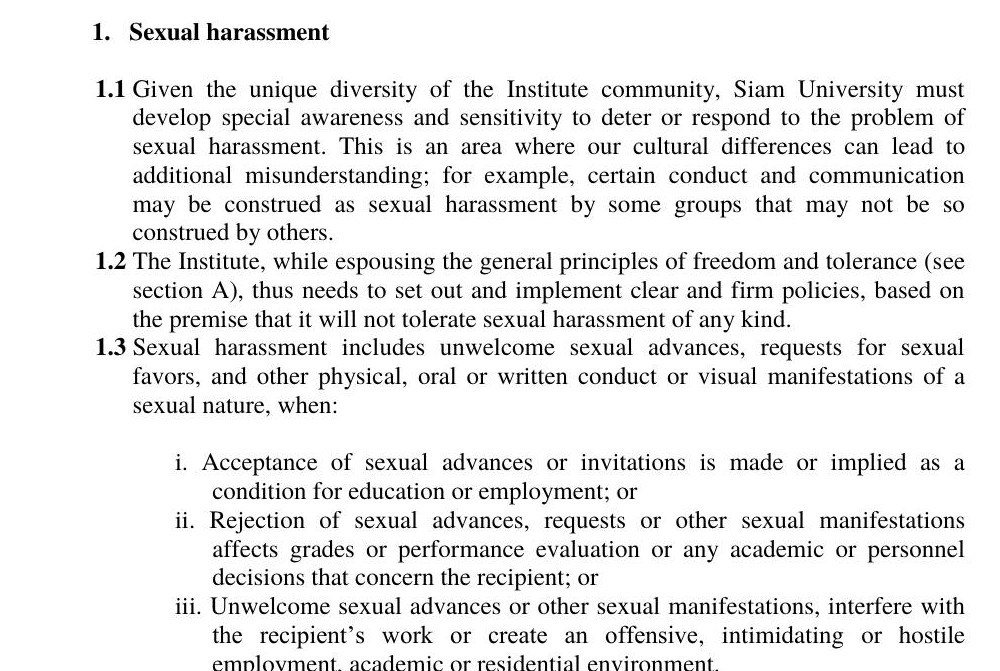 |
| Sexual harassment: the University “will not tolerate sexual harassment of any kind”; definition of unwelcome advances, requests for sexual favours and conduct that creates a hostile environment |
| 2. Confidential reporting without reprisal and grievance procedure |
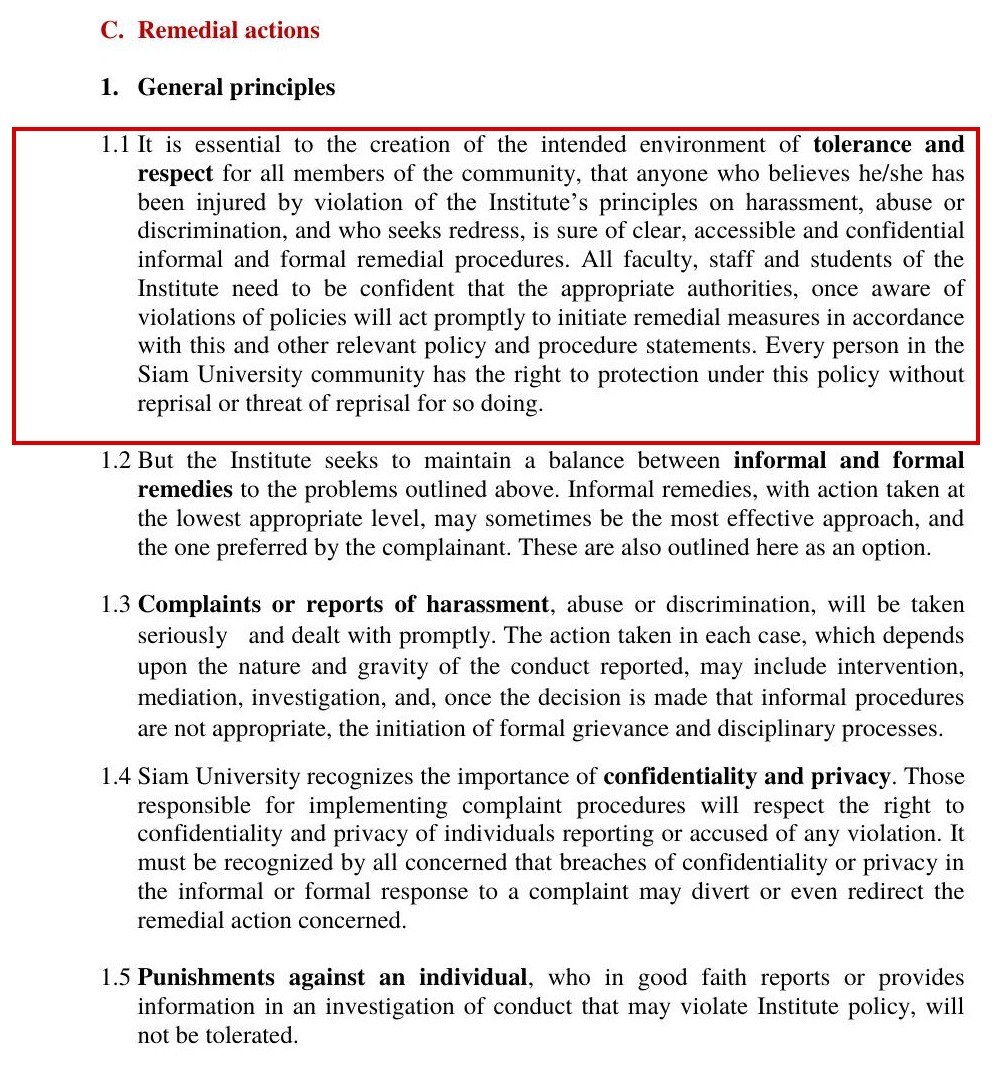 |
| Remedial actions: clear, accessible and confidential procedures; protection “without reprisal or threat of reprisal” (red box); confidentiality and privacy; no punishment for good-faith reports |
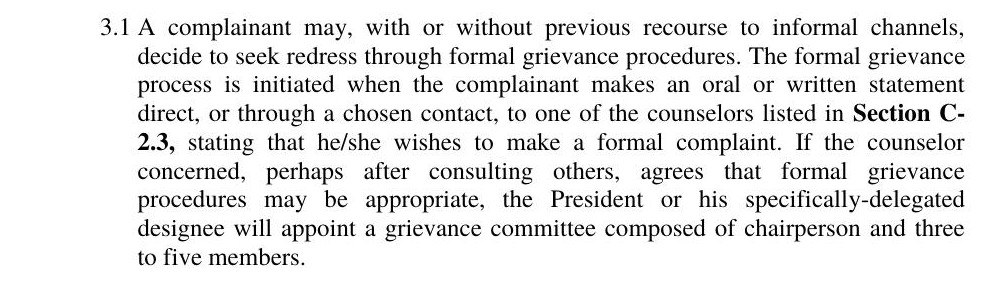 |
| Formal procedure: a formal complaint through a chosen counsellor; the President appoints a grievance committee of a chair and three to five members |
| 3. Student discipline rules |
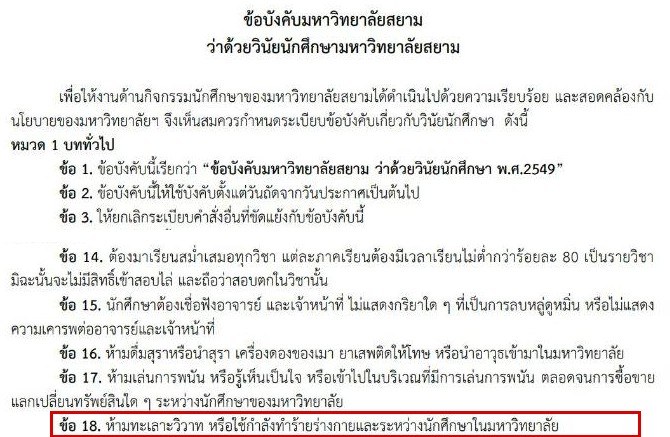 |
| Siam University Regulation on Student Discipline B.E. 2549, clause 18: students may not quarrel or use force to assault one another (Office of Student Affairs, sa.siam.edu) |
| 4. Support and emergency contacts |
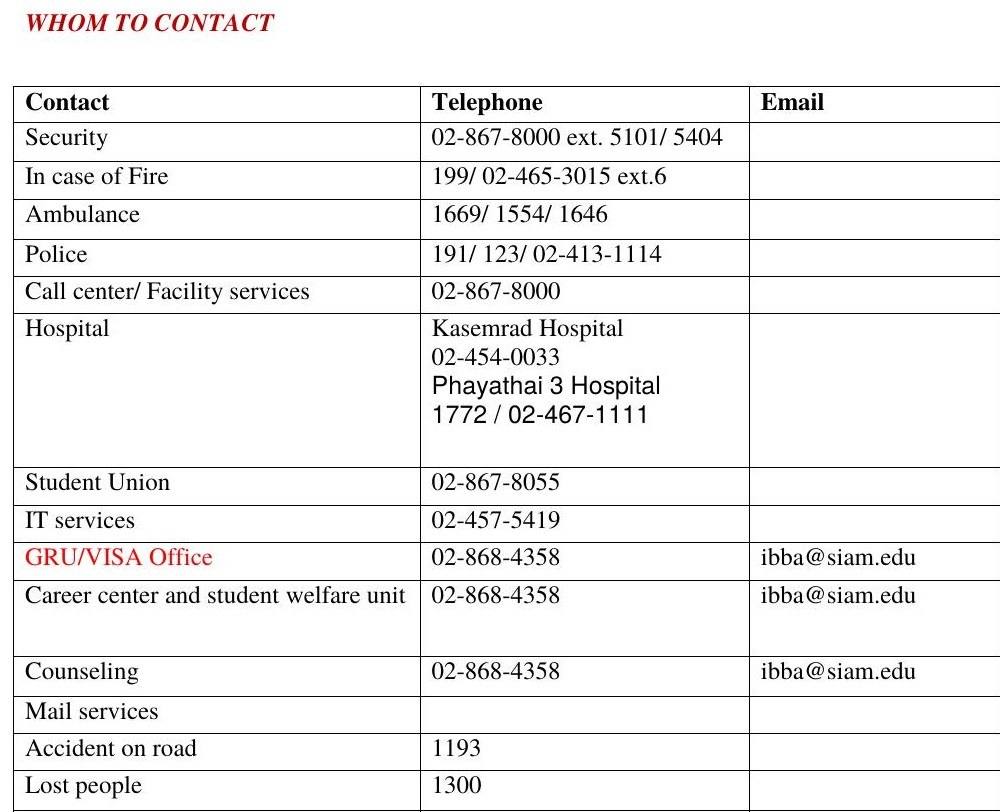 |
| Student Handbook – whom to contact: campus security, counselling, student welfare, police, ambulance, hospitals and the 1300 hotline |
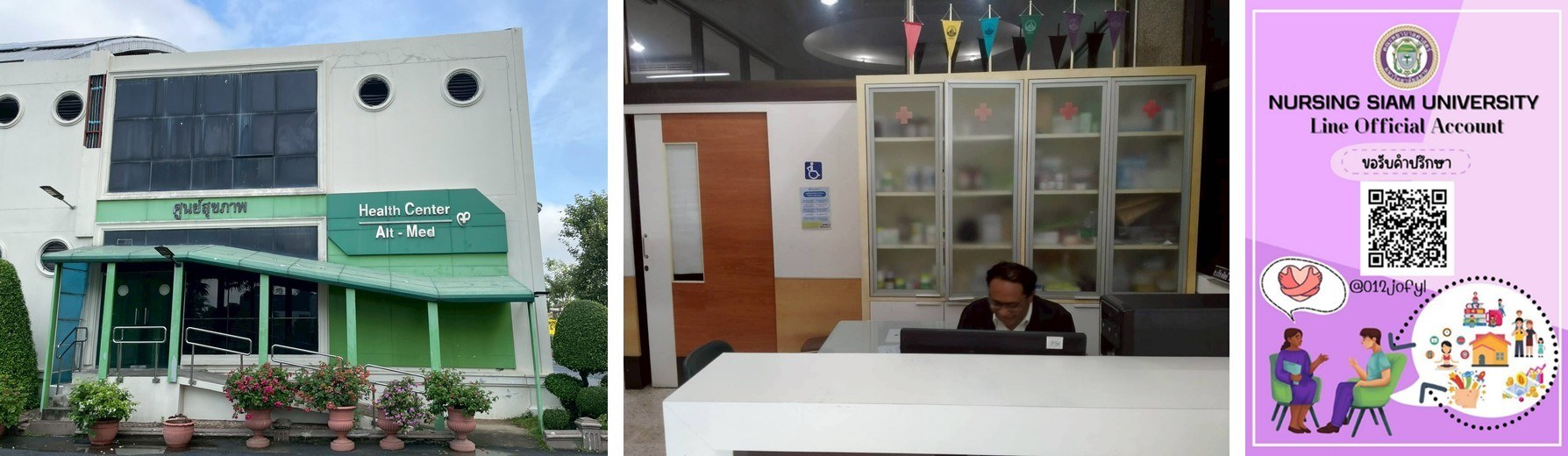 |
| Health Center and Medical Clinic (Building 15) and the Faculty of Nursing LINE Official Account for confidential health and mental-health advice |
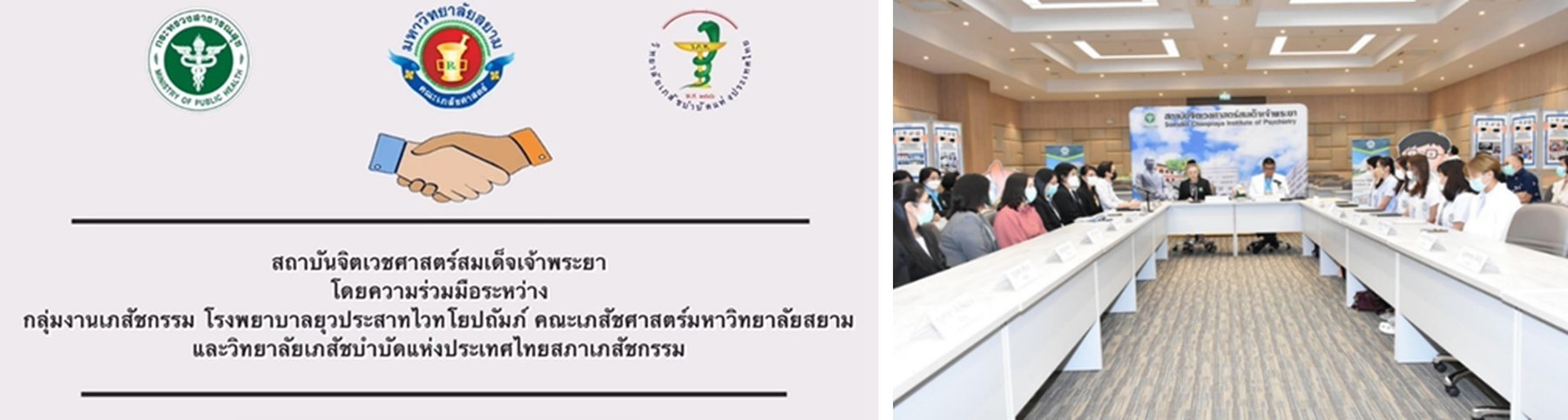 |
| Specialist referral: MoU between the Somdet Chaopraya Institute of Psychiatry, Yuwaprasart Waithayopathum Hospital, the Faculty of Pharmacy of Siam University and the College of Pharmacotherapy of Thailand |
| Measures against violence, bullying and sexual harassment at Siam University (Siam University, Thailand) |
Description:
Siam University is committed to a safe, fair and inclusive campus. Its Harassment Policy, published in the Student Handbook, applies to trustees, faculty, staff and students on campus and at official off-campus activities. It states that the University will not tolerate sexual harassment of any kind and forbids bullying and intimidation, invasion of privacy, abuse of supervisory authority and discrimination, including on gender and sexual orientation. The Regulation on Student Discipline forbids quarrelling and assault between students, and the International College Student Code of Conduct (2025) prohibits physical or sexual assault, hazing, verbal abuse, threats, intimidation, harassment and coercion.
Reporting without fear. Anyone affected can choose confidential consultation with trained staff, direct communication, third-party intervention or a formal complaint to a grievance committee appointed by the President (Table ZT 5.1.3). The policy protects everyone who reports “without reprisal or threat of reprisal”, keeps complaints and hearings confidential, and sets time limits for each step.
Prevention and support. The beauty pageant at freshmen welcome events was replaced by the inclusive Siam Ambassador programme, student councils run Pride Month campaigns, and 799 students took part in Dhamma Studies in academic year 2025. People affected can receive confidential counselling, medical care at the University Medical Clinic and legal advice at the Faculty of Law’s Legal Counselling Center, and are referred to the One Stop Crisis Center (1300), the Department of Mental Health (1323) or the Somdet Chaopraya Institute of Psychiatry.
Selected level: 4 Items or More – 30 of 30 points. [Add 2025/2026 records: respect or anti-bullying sessions, the number of complaints handled, security monitoring and support usage (Table ZT 5.1.4).]
Score calculation – ZT 5.1 (30 points)
Measures in place (Table ZT 5.1.1): items 1, 2, 4 and 5 = 4; item 3 partly → 4 Items or More → 30 × 1.00 = 30 points. Orange row: 30 × 0.75 = 22.5 points. Weights from the HURS 2026 online form.
| ZT 5.1 level | Weight | Points (of 30) | Siam University |
|---|---|---|---|
| None | 0.00 | 0 | |
| 1 Item | 0.25 | 7.5 | |
| 2 Items | 0.50 | 15 | |
| 3 Items | 0.75 | 22.5 | If diversity programmes are not accepted as violence-prevention education |
| 4 Items or More | 1.00 | 30 | Selected – 4 measures in place, 1 partly (Table ZT 5.1.2) |
Table ZT 5.1.1 – HURS measures against violence, bullying and sexual harassment
| HURS measure | Implementation at Siam University | Evidence | Status |
|---|---|---|---|
| 1. Formal policies that clearly prohibit violence, bullying and sexual harassment |
Student Handbook (International College), Harassment Policy: applies to trustees, faculty, staff and students on campus, at outreach centres and at official off-campus activities; states that the University “will not tolerate sexual harassment of any kind” and defines it (unwelcome advances, requests for sexual favours, conduct that creates a hostile environment); forbids bullying and intimidation by physical force, threats or humiliating remarks, invasion of privacy, abuse of supervisory authority, and discrimination, including on gender and sexual orientation. Regulation on Student Discipline: no quarrelling or assault between students (clause 18), no disturbances (clause 9) or misconduct (clause 22). ICO Student Code of Conduct (2025): prohibits physical or sexual assault, hazing, verbal abuse, threats, intimidation, harassment and coercion, with sanctions up to dismissal. Healthy University Policy: diversity and inclusion. |
Photos 1, 3; Student Handbook, pp. 23–26; Regulation on Student Discipline; ICO Student Policies |
In place |
| 2. Educational programmes that prevent these behaviours and promote a respectful campus |
The traditional campus beauty pageant at freshmen welcome events was replaced by the Siam Ambassador programme, open to students of all gender identities and judged on ability and ideas; faculty student councils run Pride Month campaigns; students and staff research LGBTQ+ issues and the library holds LGBTQ+ resources. Moral education: Dhamma Studies (academic year 2025: 799 students enrolled, 426 passed). The Harassment Policy commits the University to train a group of deans, heads and student-affairs staff to give confidential advice. |
SDG 5 and SDG 16 pages; Student Handbook, p. 27 | In place – add 2025/2026 respect and consent sessions |
| 3. Surveillance programmes to monitor and address incidents | The Student Discipline Committee supervises, monitors and corrects student conduct with lecturers, advisors and staff (clause 6). At the International College, violations must be reported to the instructor, programme director or authorities within two weeks and are forwarded to the Disciplinary Committee. Grievance committees can ask the President to authorise an investigation. The campus security office (ext. 5101/5404) is on duty. |
Regulation on Student Discipline; ICO Student Policies; Student Handbook, pp. 28, 36 |
Partly – add security monitoring and incident records |
| 4. Confidential reporting without fear of reprisal | Harassment Policy, Section C: every member of the community “has the right to protection under this policy without reprisal or threat of reprisal”; complainants have clear, accessible and confidential informal and formal procedures; punishment of anyone who reports in good faith “will not be tolerated”. Confidential “off the record” consultation is available with trained deans, heads and student-affairs staff, without naming the other person or even the person consulting. Formal complaints go to a grievance committee of a chair and three to five members appointed by the President; notice of the hearing within five working days, the hearing within ten working days, closed hearings and confidential findings, and a report to the President within two working days. The International College grievance policy also handles complaints of harassment and bullying confidentially. |
Photos 2; Student Handbook, pp. 26–30; ICO Student Policies, section 5 |
In place – add the number of complaints handled |
| 5. Rehabilitation and empowerment for people affected | Remedies under the Harassment Policy include agreements on future conduct and changes in study or workplace assignments. Confidential counselling, crisis intervention and referral for students and staff (Health and Well-being Policy); personal counselling through the International College office and the Guidance and Counselling Office; an academic advisor for every student; the University Medical Clinic (Building 15); the Legal Counselling Center of the Faculty of Law (Building 3). External referral: One Stop Crisis Center 1300, Department of Mental Health hotline 1323, the Somdet Chaopraya Institute of Psychiatry; emergency contacts – security, police 191 and ambulance 1669. |
Photos 4; Student Handbook, pp. 22, 28, 36; Healthy University Policy; SI 3.2 |
In place – add support usage numbers |
Table ZT 5.1.3 – Complaint channels and procedure
| Step | Channel | What happens (Harassment Policy, Section C) |
|---|---|---|
| 1 | Confidential consultation | Talk “off the record” with a trained dean, head, student-office coordinator or student-affairs staff member; the other person, and even the person consulting, need not be named. |
| 2 | Direct communication | The complainant tells or writes to the other person that the behaviour must stop, with advice if wanted; any reprisal is itself harassment. |
| 3 | Third-party intervention | A neutral person meets both sides to agree future conduct, changes in staff, or changes in study or workplace assignments. |
| 4 | Formal complaint | Oral or written statement to a listed counsellor; the President appoints a grievance committee of a chair and three to five members. |
| 5 | Hearing | Notice within five working days and at least 72 hours before the hearing; hearing within ten working days; closed to others; records confidential. |
| 6 | Decision | Committee report to the President within two working days; the President decides on disciplinary action under university rules and Thai law. |
Source: Student Handbook, International College, version 3/2021, Harassment Policy, Section C (pp. 26–30).
Evidence to attach:
-
Student Handbook, International College, version 3/2021 – Harassment Policy (pp. 23–30), Student Affairs (p. 22), Whom to Contact (p. 36): http://www.inter.siam.edu/
-
Regulation on Student Discipline B.E. 2549 (clauses 6, 9, 18, 22): https://sa.siam.edu/wp-content/uploads/2024/01/sa_2566.pdf
-
ICO Student Code of Conduct and grievance policy: https://ico.siam.edu/student-policies
-
Healthy University Policy: https://sustainability.siam.edu/vision-mission-and-policies-for-sustainable-future/; Siam Ambassador and Pride Month – SDG 5 page: https://sustainability.siam.edu/goal-5/; SDG 16 page: https://sustainability.siam.edu/goal-16/